



Products
Product Line
We introduce a wide range of products backed by Geumah Steel’s technological expertise.
We supply various products including cold-rolled steel sheets (CR, EGI, GI / HGI, GA, PCM, VCM), hot-rolled steel sheets (PO, HR), and non-ferrous metals (STS, copper, aluminum, etc.).
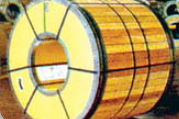
PO
Pickled Oiled Coil
This product is produced by removing mill scale and impurities attached to the surface of hot-rolled steel sheets through a pickling line (POL), improving flatness through a skin pass mill, and then applying oil. It compensates for the weaknesses of general hot-rolled steel sheets such as paintability, corrosion resistance, surface quality, and formability. It is used in construction materials, automotive parts, electrical and electronic components, and general machinery.
CR
Cold Rolled Steel
CR products, commonly referred to as cold-rolled steel sheets, are produced by removing scale (rust) and impurities from hot-rolled coils through a pickling process, then reducing thickness through rolling mills by applying compressive force. The hardened material is improved through heat treatment to secure formability, surface roughness, and flatness. The term “cold-rolled products” is used broadly to include not only CR products processed through pickling, rolling, and heat treatment, but also products that undergo subsequent plating or surface treatment. Unlike plated products, cold-rolled products do not have a protective layer to prevent oxidation, so they are generally distributed in an oiled condition.
EGL
Electrolytic Galvanized Iron
Electrolytic galvanized steel sheets are produced by applying a thin and uniform zinc coating to CR products using an electroplating method, enhancing corrosion resistance. Due to the small zinc coating weight and dense, uniform plating, these products offer excellent paintability and corrosion resistance after painting. Since the plating process is carried out at near room temperature, the original material properties of the CR base metal are maintained, allowing a wide range of material selection and excellent formability.

GL
Galvanized Iron
GL products, the most widely used surface-treated steel sheets, are produced by continuously annealing pickled and rolled full-hard products on a CGL line, securing the required material properties, and passing them through a zinc bath at approximately 460°C to apply a zinc coating. Compared to EG products, they have a relatively thicker zinc layer and are classified into regular spangle and zero spangle depending on the surface crystal pattern formed during solidification. To prevent white rust caused by contact between the zinc layer and air, chromate treatment is generally applied. GL products are widely used as construction materials and also serve as the most common base material for color-coated steel products.

Hi-Galvalume
Zn-Al Alloy Coated Steel Sheet
Developed by Bethlehem Steel in the United States around 1965, this Zn-Al alloy coated steel sheet consists of 55% aluminum, 1.5% silicon, and the balance zinc, featuring a distinctive spangle pattern. It offers intermediate performance between zinc-coated and aluminum-coated steel, and is also referred to as zinc-aluminum alloy coated steel. It is used in construction materials, automotive components, exhaust systems, heat exchangers, air conditioners, and oil stoves, and is considered superior to zinc-coated steel in terms of corrosion resistance and heat resistance.
HGI
Hot Rolled Galvanized Iron
This refers to steel sheets produced by directly hot-dip galvanizing hot-rolled steel sheets without undergoing cold rolling after pickling. Since a skin pass mill (SPM) process is applied after galvanizing, these products exhibit superior surface quality and corrosion resistance compared to conventional hot-rolled steel sheets, and effectively suppress the occurrence of white rust. They are widely used for construction materials, pipes, and guardrails.
GA
Galvannealed Steel Sheet
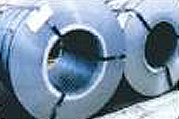
Also known as galvannealed steel, this product is produced by applying a hot-dip zinc coating similar to GI products, followed by special heat treatment immediately after galvanizing to form a Zn-Fe alloy layer between the base steel and the zinc coating. Due to the iron content in the coating layer, the surface appears dark gray. It offers excellent weldability, paintability, and corrosion resistance under coatings, making it widely used for automotive steel sheets.
ALCOSTA
Aluminum Coated Steel Sheet
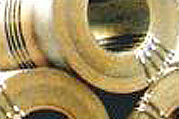
ALCOSTA is used for heating equipment and automotive exhaust systems due to its excellent corrosion resistance and heat resistance, which are far superior to those of zinc-coated steel, galvalume steel, and cold-rolled steel. Even after long-term use at high temperatures of 450°C, there is no surface damage or discoloration. At higher temperatures, the surface transforms into an Al-Fe alloy layer, changing color while maintaining heat and corrosion resistance, and it can be used up to approximately 600°C. Its highly attractive surface also provides excellent heat reflectivity of about 80% at 450°C, making it suitable for reflectors in toasters, gas ranges, oil stoves, and gas ovens.

COLOR
Color Coated Steel Sheet
Color-coated steel products are the highest value-added products among cold-rolled steel sheets. Using CR, EGL, GI, AL, STS, and other materials as substrates, they are produced by coating various colors according to customer requirements and end-use applications, followed by curing. Various types of resins can be applied depending on color and base material. Steel sheets painted in sheet or coil form before fabrication are collectively referred to as PCM.
STS
Stainless Steel
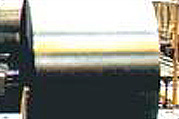
Stainless steel, also known as corrosion-resistant steel, does not rust. There are chromium stainless steels and chromium-nickel stainless steels, with the latter represented by 18-8 stainless steel containing 18% chromium and 8% nickel. It offers excellent corrosion resistance, oxidation resistance, heat resistance, as well as good mechanical strength, formability, and weldability. It is widely used in chemical, food, and construction applications, as well as household goods, nuclear industry, and aerospace industry. KS standards specify stainless steel grades such as STS 304 (18-8 standard grade) and STS 430 (13-chromium standard grade).

HR
Hot Rolled Steel Coil
This refers to steel sheets rolled at high temperatures, typically above approximately 800°C (above the A3 transformation point), and is commonly abbreviated as hot-rolled steel sheet, H/C, or HR.